
A bedside nurse on nursing workload measurement, nurse-patient assignment, and what The Joint Commission's NPG 12 now asks hospitals to show.
I want to show you a box.
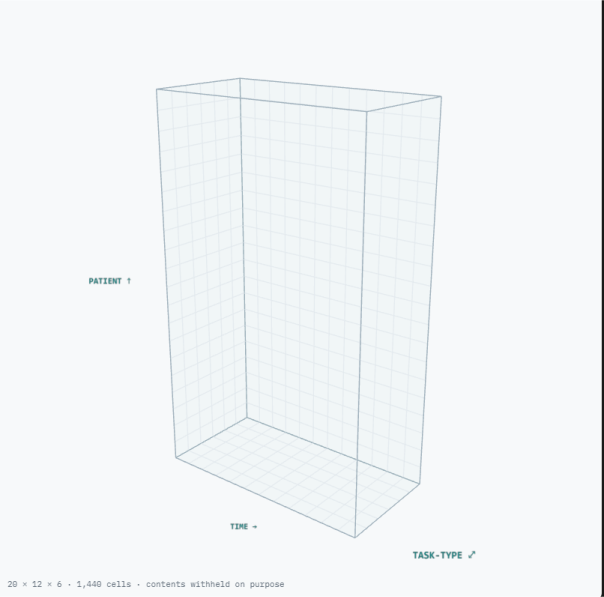
Right now it looks empty. Twenty rows tall, twelve columns wide, six layers deep. The labels say Patient, Time, and Task-Type. Nothing else.
Here is what I will tell you about it. This box holds every hour of nursing work on a 20-bed unit across one 12-hour shift. Every med pass. Every assessment. Every bath and turn. Every chemo initiation, every note, every procedure. All 1,440 cells of it.
I left it empty on purpose. Stay with me.
I am a bedside nurse. I have worked night shift across stepdown, ICU, BMT, and oncology. And on every one of those units, the same thing happens at 6:45, morning and evening alike.
The charge nurse looks at a census, looks at an acuity score next to each patient, and starts building assignments. Twenty to thirty minutes of cognitive load, trying to be fair, trying to be safe, trying to remember that Bed 4 is a heavy turn, Bed 9 has a family meeting, and Bed 1 starts induction chemo at 9.
The acuity score does not know any of that. An acuity score is one number. It is a summary of a summary.
Two patients can carry the exact same acuity and generate completely different shifts. One front-loads everything into the first two hours. The other spreads moderate work across all twelve. On paper they are identical. At the bedside, every nurse knows they are not.
We have all lived the assignment that was "evenly balanced on paper."
And as of this January, this stopped being only a fairness problem. The Joint Commission retired its National Patient Safety Goals and replaced them with National Performance Goals, and the new NPG 12 asks hospitals to show that staffing meets patient needs, with the right skills matched to the right patients.
And that is where every hospital runs into the same wall. You cannot show what you cannot see. And one number per patient does not let anyone see very much.
The box is what happens when you stop compressing nursing work into one number and let it keep its real shape.
One axis for every patient on the unit. One axis for every hour of the shift. One axis for the major categories of nursing work: medication administration, assessment, chemo and drips, ADL and mobility, documentation, procedures.
Patient by hour by task. That is the whole idea. Simple to say, and something acuity scores have never captured.
The data to fill it already exists. Hospitals generate it every single day as a byproduct of care: timestamped medication records, flowsheet entries, task completions. No new documentation burden. No surveys.
Is that data perfect? No. Charting lags reality, and it misses the human work between the tasks. Every nurse leader knows that. But it is far closer to the truth than one number per patient, and nurses already did the documenting. The record was always there. We just never looked at it in this shape.
Because the inside is not the point. The question is.
When you can see nursing work at this resolution, assignment stops being a guess and starts being something you can hold up to expert judgment. Our whole approach lives or dies on one test: when experienced charge nurses review assignments built this way, do they call them fair and safe?
Charge nurses are the ground truth. Not the algorithm. If the model cannot earn the agreement of the people who have been solving this problem in their heads for decades, the model is wrong. Period.
That is the work we are doing now, and it is why I wanted to start this conversation with an empty box instead of a finished dashboard.
You know what turnover costs. You know what an unfair assignment does to a nurse's shift, and what a run of them does to a nurse's career.
So here is my question, and I genuinely want your answer:
If you could see one hour of one shift at full resolution, every task, every patient, every overlap, which hour would you pick, and what do you think it would show you?
Email me at careml@inteleqtus.com, or find me on LinkedIn. I read and answer everything.
Amiel Pilit, RN, BSN is a bedside nurse and the founder of Inteleqtus, where he is building SPARK, a nurse-patient assignment platform designed with charge nurses, not around them.
Related reading:


Start with a Discovery Audit. We analyze 90 days of your agency invoices and deliver a CFO-ready report with verified findings — in 5 to 10 business days. If we find less than the audit fee in recoverable discrepancies, you pay nothing.
Intelligent automation for healthcare operations.
Inteleqtus builds rules-based tools that help hospitals optimize nurse staffing
and catch premium labor billing discrepancies — with full audit trails and zero PHI required.
Optimal assignments generated from acuity, competency, & fatigue data.
Your charge nurse already pulls a census every shift. Upload it to SPARK instead of building assignments manually.
In billing discrepancies found during a single 90-day discovery audit.
Contract Labor is the fastest-growing line item in hospital budgets. SPARK reduces your reliance on agency staff by optimizing internal assignments. LeakLock catches overbilling when you do use agencies. Together, they close the loop — fewer agency shifts needed, fewer billing errors when they are.
Optimal nurse-patient assignments in under 60 seconds. SPARK uses constraint-based optimization to balance workload, match certifications, and produce audit-ready documentation — while keeping every assignment editable by the charge nurse.
Agency invoices contain errors. Every hospital. Every quarter. LeakLock runs a forensic reconciliation across your invoices, timekeeping records, and rate cards to find rate overcharges, phantom hours, duplicate billing, and contract violations — with documentary evidence for every finding.
Built by people who understand hospital operations — our tools reflect real clinical workflows, not theoretical models
Minimal Data Footprint — works alongside Epic, Cerner, or any existing system
No IT involvement needed — LeakLock runs on CSV exports; SPARK opens in any browser
Lightweight data footprint — SPARK runs on acuity scores, census counts, and staffing levels, not clinical records.
Supports TJC NPG 12.06.01 — audit-ready assignment documentation with competency-to-patient mapping
Start with a Discovery Audit. We analyze 90 days of your agency invoices and deliver a CFO-ready report with verified findings — in 5 to 10 business days. If we find less than the audit fee in recoverable discrepancies, you pay nothing.